Series A investor briefing · September 2026
The operating system for recovery after cardiac arrest and stroke
Acute care was solved. The twenty-four months after it were not.
- Series A
- NOK 50M
- USD 5.4M
- Pre-money
- NOK 100M
- USD 10.8M
- Entry price
- NOK 1,000
- per share, both phases
Press → or use the rail below. Drag the model to rotate it.Swipe left or right to move between slides.
The gap
The problem is not the surgery. It is the two years after it.
Over 24 months, twelve identifiable factors dismantle the recovery the surgery paid for: depression and anxiety in around a third of stroke patients, cognitive impairment in 25–55%, sleep apnoea in 50–67%.
NIHSS, Barthel, modified Rankin and EQ-5D are snapshots taken at discharge. For the 24 months that follow, no instrument is watching.
Who pays
The bill lands on three budgets that never meet
A failed recovery arrives at the municipality as home care, at NAV as disability, at the pension system as early draw-down, and at the family as unpaid hours and lost work.
Medioteq is the first digital infrastructure designed to track, measure and monetise continuity of care across all three financial silos.
The platform
Patient One: one platform, every device, one score
An MDR-grade AI gateway connecting hospitals, rehab and patients, validated through an exclusive 24-month clinical programme with Oslo University Hospital.
412 Western and 88 BRICS and non-OECD medical devices aggregated into a single data layer, built on the DAD device taxonomy.
A composite outcome score: 60 points clinical across seven domains, 40 points socioeconomic across four. The economic weighting is the innovation.
The NASR digital twin pairs clinical and socioeconomic modelling around each patient. The twins run on synthetic patient databases, so development never waits in a data-access queue.
Warranty Trust Level is a four-tier certification that keeps clinical AI data trustworthy and auditable in any jurisdiction. It carries a record from Tromsø to Stockholm, Oslo to Dubai and Bergen to Nairobi, under blockchain consent and EHDS compliance.
Rankin-Horn Index
RHI-100 scores recovery the way society pays for it
60 points measure clinical recovery from hard data such as mRS, NIHSS and CPC. 40 points measure socioeconomic burden: income loss, care dependency, and return to daily activities and work.
A mild stroke that ends in permanent work disability scores worse than a severe stroke where the patient returns to work. The AI is optimised for what actually costs society the most.
Example patients with illustrative values. The index is built and pre-validated against a registry of 75,000 ischaemic stroke patients (2015–2024).
Already built
What this round starts from
This round funds new development. The figures below are the base it builds on, not an installed customer base.
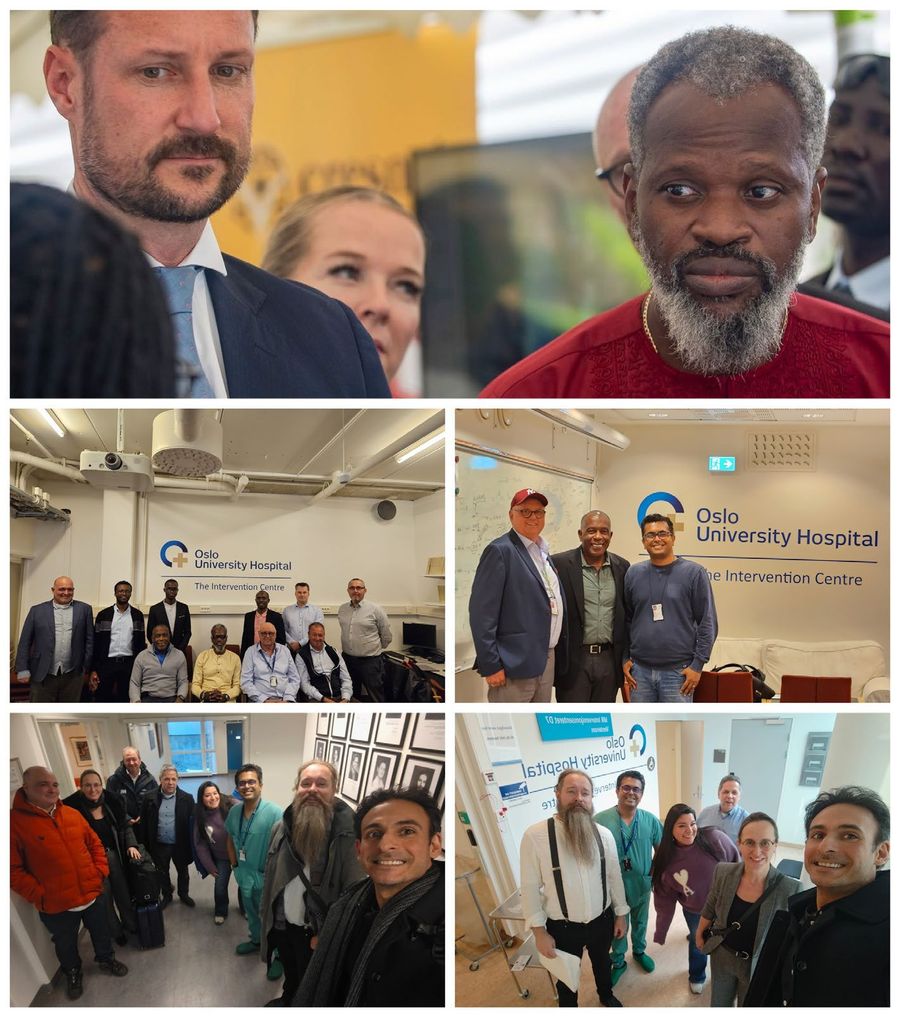
Partnership with Oslo University Hospital, The Intervention Centre. The solution is under test against a digital twin built on real statistics and published health data.
Footprint
From Norway to the world
5,000 patient touchpoints nationwide at full rollout, extending care to distance-denied catchments such as Finnmark and Lofoten where public provision fails.
Economics
The efficiency programme nobody could build
Public and private meet at this seam, and fail. Every party below gains; none of them could ever collect it alone.
- Hospital / RHA
- NOK 2.25MUSD 242k
- carried per patient on a fragmented pathway at RHI-100 score 42
- NAV
- NOK 420kUSD 45.2k
- in avoided disability
- Municipality
- NOK 180kUSD 19.4k
- in reduced home care
- Clinician
- 70–80%
- cut in multi-payer administrative burden
- Direct healthcare savings
- NOK 550MUSD 59M
- Indirect: productivity and caregiving
- NOK 250–500MUSD 27–54M
- Patient travel reduction
- NOK 80–120MUSD 9–13M
- Payback from full deployment
- 12–24 months
Five years: NOK 3.25B in, NOK 13.55B out. That is NOK 10.3B net, a 3.2x return to the public purse (USD 350M in, USD 1.46B out, USD 1.11B net).
Modelled from documented Norwegian baselines and international comparators: estimates, not measured outcomes. Lifetime differential per avoided disability taken at NOK 2.5M, the conservative end of a NOK 2.0–4.0M range. Converted at NOK 9.29 = USD 1 (12 Sept 2026).
Defensibility
Why this cannot be copied
Two decades of clinical culture is the price of entry. The measurement layer is what keeps the lead.
No prior art
RHI-100 is proprietary. Nothing else combines clinical and economic burden in a single score.
No data queue
Paired digital twins run on synthetic patient databases, bypassing the data-access bureaucracy.
No border
WTL carries a record across borders under blockchain consent and EHDS compliance.
Already contracted
Monsenso, Brain+, Nox Medical and Afya Rekod build under Medioteq IPR contracts, with deliverables vesting in Medioteq.
Neither benchmark measures total health-system burden, integrates economic outcomes or carries a record across a border. What capital buys is deployment speed, in the window before a slower competitor reaches the same insight.
Business model
How we get paid
Medioteq licenses the index and the platform, and is paid out of the savings it is the first to make attributable.
- Hospital
- NOK 40,000per 3-week episode
- Rehab centre
- NOK 40,000per 3-week episode
- Home care
- NOK 1,900per month, 6 months
- Local doctor
- NOK 15,000per seat, per year
- Workplace
- NOK 15,000per seat, per year
Subscription penetration modelled at 5% in 2027 rising to 25% in 2030, on top of consultancy revenue.
A customer saving NOK 1.05M per patient has both the capacity to pay for the instrument that produced the saving, and the reason to keep paying across the whole cohort.
Path to revenue
Four sequenced streams to NOK 257M ARR by 2030
Early streams fund operations through the SaaS build, and execution risk falls as each one lands.
The coral line in the model is execution risk, falling as each stream comes online.
The round
Series A: NOK 50M
- Raise
- USD 5.4M
- NOK 50M
- Pre → post
- 100 → 150
- NOK M · USD 10.8M → 16.1M
- Per share
- NOK 1,000
- both phases, no step-up
Phase 1 bridge
NOK 5M across 5,000 shares, tickets NOK 1–3M. Clears legacy audits, sets up the HoldCo and documents the IP.
Phase 2 institutional
NOK 50M across 50,000 shares, at the same NOK 1,000 per share. Early investors face no price penalty.
Use of proceeds
A 30-month runway to MDR-grade validation
A fully mapped plan burning NOK 1.5–1.7M a month removes urgency and execution risk while the clinical evidence is built.
Every private krone unlocks up to 1.5 grant kroner. SkatteFUNN returns about 19% of eligible R&D, and Gaveforsterkning adds about 25% state match on research donations.
Risk
Each major risk has a structural answer
The full method stack is assigned or exclusively licensed to the company, cleared by novelty and freedom-to-operate work before filing, converted into a filed portfolio when the round closes, and held in one domicile, the Irish entity.
Liquidity
Event horizons and a pre-agreed path to liquidity
- Target EV
- USD 800M
- NOK 8.8B
- Price per share
- NOK 38,000
- from NOK 1,000 entry
- Multiple
- 38x
- at Q4 2030 exit
Modelled with the Medioteq Bifurcation Framework v3.0. Forward-looking projections are subject to change.
Team
Clinical validation backed by commercial execution
Eilert Bredo Lund
CEOCompany operations, commercial partnerships, fundraising and international partnership development.
e.lund@medioteq.no
Hassan Nasr
CTOLeads the technical build of Patient One: architecture, AI development and WTL framework design.
h.nasr@medioteq.no
Nils-Ivar Dyngeland
CSO & FounderCreator of the DAD device taxonomy; PhD research in medical device aggregation.
n.dyng@medioteq.no
Ketil Horn
Chairman & Head of ResearchGovernance, strategy and lead investor contact; drives the Series A raise.
k.horn@medioteq.no
Tetiana Yaroshenko
GDPR & IP Manager · Provisional Data Protection OfficerCDPO certified. Leads IP strategy and patent filings, and data protection across the platform.
t.yaro@medioteq.no
Ketil Horn (Chair) · Dr Ronald M. Harris, MD, strategic clinical oversight · Per Aarø
Ræder Bing (legal) · Norus (accounting) · M2 Revisjon (audit) · Afya Rekod (strategic shareholder) · Oslo University Hospital and Inven2 (clinical validation)
4 of 10 planned organisational roles are held by women, for balance and because they are the most skilled candidates.
Next steps
The two years nobody owns.
Phase 1 is closed. Phase 2, NOK 50M, is open.
- 01Mutual NDAUnlocks the data room: Budget v3.0, Master Tracker, Bifurcation Model.
- 02Due diligenceFinancials, OUH term sheet, IP strategy memo and WTL technical documents.
- 03Offer letterA named ticket allocation in NOK 1M–3M ranges.
- 04SubscriptionExecute the agreement and transfer per hard closing deadlines.
- 05RegistryShares registered in the Medioteq AS cap table.
Ketil Horn, Chairman & Head of Research
k.horn@medioteq.no
medioteq@medioteq.no
Fridtjof Nansens vei 17–19
0369 Oslo, Norway
Strictly confidential. Investments involve risk. Forward-looking projections are subject to change. Independent financial and legal advice is recommended before investing.